NutriMagnus - For those who choose intelligent eating
By: Tom Cloyd - 9 minute read
(Reviewed: 2026-06-12:1700 Pacific Time (USA))
Page contents...
(The following page is seriously incomplete and under very active development. It has consumed a full 8 hours of my Thursday. Be assured that there is more to come. This is a casual, but detailed, introduction to NutriMagnus.)
The breakfast challenge: harder than you may think
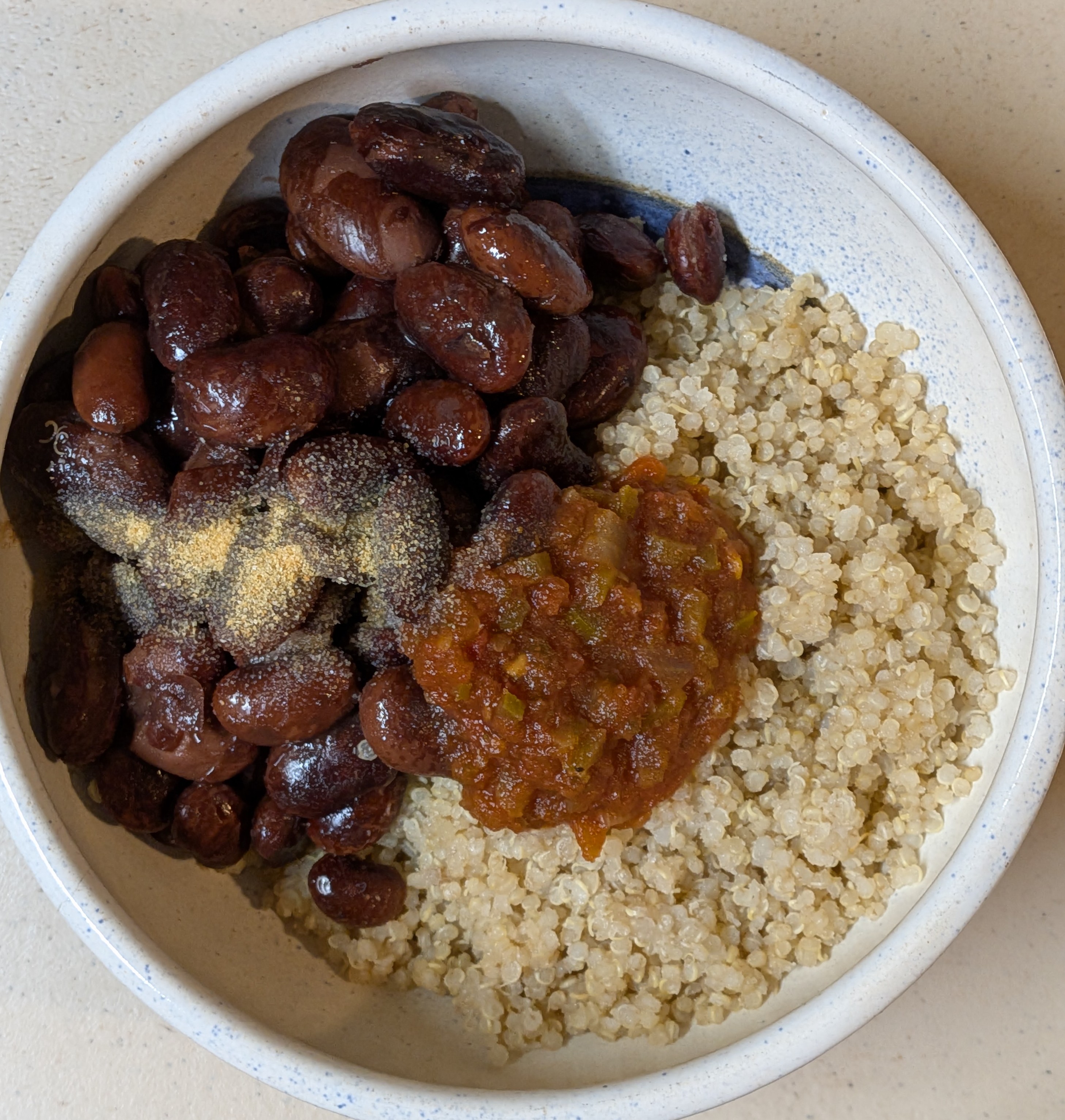
CLICK TO ENLARGE -- PRESS ESC TO RETURN
Let me take you through a practical problem I just dealt with: Putting together a good breakfast.
Your first thought may be...eggs, potatoes, toast, jam, orange juice...uh, nope. That one won't even come close to being good enough.
I start with cooked quinoa - a seed grown in South American that is unusually nutritious, as you will see. It looks like grayish millet - yes, bird seed - but is far more nutritious than either that or the much more universal rice. There's about a cup of it in the bowl.
Putting the empty bowl on my kitchen scale, I zero it out, and then weigh about a cup of quinoa - 123 grams in this case.
Beside the scale I have a simple slip of paper - a quarter sheet of 8x12" paper - and a pen. I'm keeping a record of the weight in grams of the important food that goes into my bowl.
As a sidenote - it would also work to record weight in ounces, or volume in any of the familiar volume measures - ccs, tablespoons, cups - whatever is handy and familiar for you.
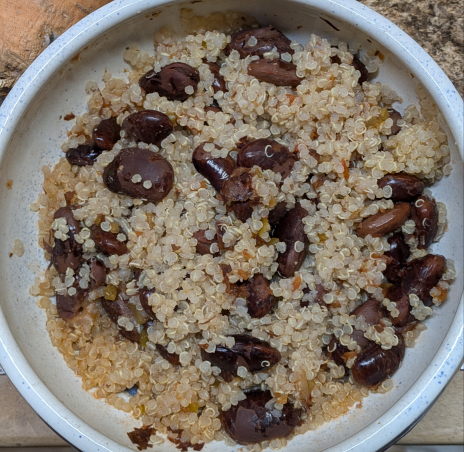
CLICK TO ENLARGE -- PRESS ESC TO RETURN
Then I add my beans - in this case about a cup of homegrown Scarlett-runner beans. Fat and tasty, and I much recommend them, but they will cause a problem shortly.
Since I forgot to zero out the scale again, it now reads 417 grams. A bit of subtraction and I have my beans weight at 294 grams. These weights will be needed very shortly.
Starting with this very basic mix, I then fancy it up a little:
- Heat 1/4 cup of water fairly hot in my ancient microwave, then add 1/2 t vegetable broth paste and stir well. I pour this over my beans and quinoa.
- Sprinkle 1/4 t garlic granules over the mix, and also add 2 T of salsa.
- Stir it well and heat it in my microwave.
Stirred again, it's ready to be my breakfast. Everything in it is solid food, and both major foods are excellent protein sources. At least it seems reasonable to think so.
A preview of the problem - a nutrient analysis of this breakfast meal
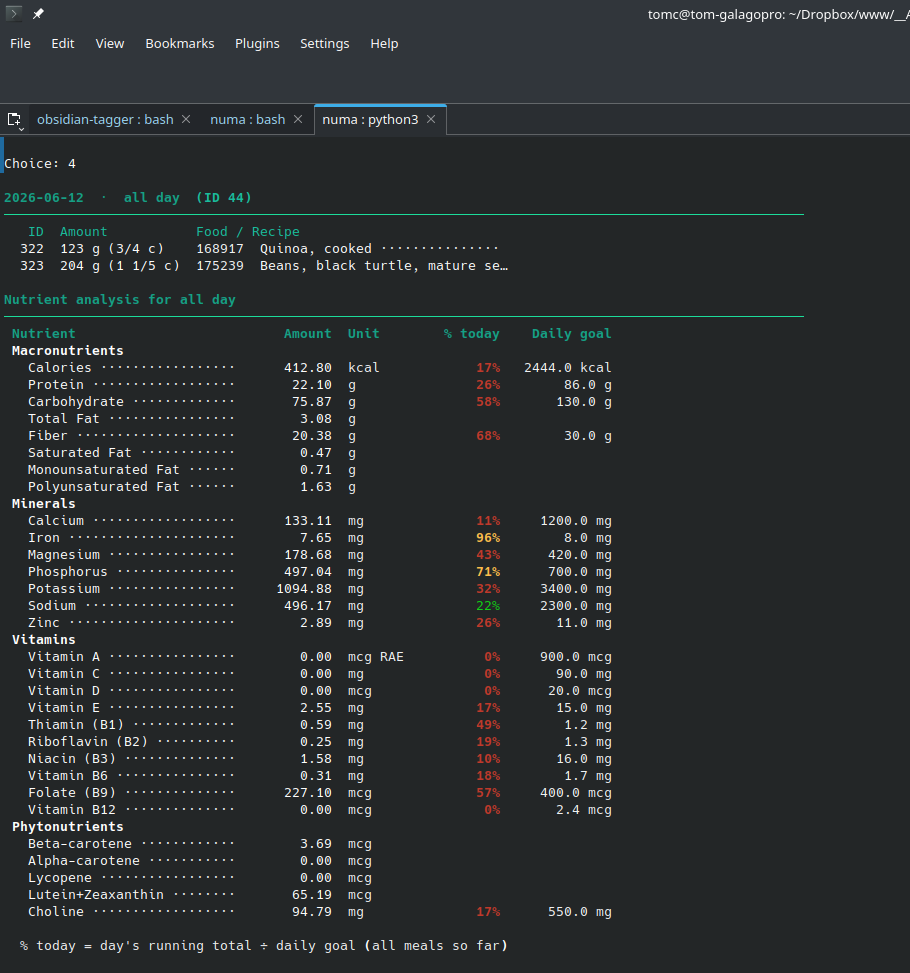
NutriMagnus come in two versions. One runs in your browser as if it were a website. This is a familiar working environment for most people and easy to look at. The run runs in a terminal emulator program. Many people have never used such a program, but back before browsers were common everthing on the Internet was access through a physical teletype machine, and then a keyboard terminal with a video screen. When I first started running computers, I ran the night shift on the U. of Utah's million dollar Univac 1108 computer. Everything was run through a terminal, and it definitely didn't look as interesting as the picture below.
CLICK TO ENLARGE -- PRESS ESC TO RETURN
Click it to enlarge the image (esc to return) and you'll see the first part of the nutrient analysis for this meal produced by NutriMagnus. The nutrients are in 4 groups. The name of the meal analyzed is "All day" because I don't usually store my day's food in separate meals. So this is what I've eaten so far on this date.
Note that the profile for myself that I have set in the program results in a set of nutrient goals, shown in the last column.
Disappointingly, that sizeable serving of beans only amounted to about a quarter of my protein goal for the day. The situation is actually worse than it appears, for the figure shown is raw protein. In reality, not all that protein is necessarily available to me. Plant proteins are always only partly digestible.
CLICK TO ENLARGE -- PRESS ESC TO RETURN
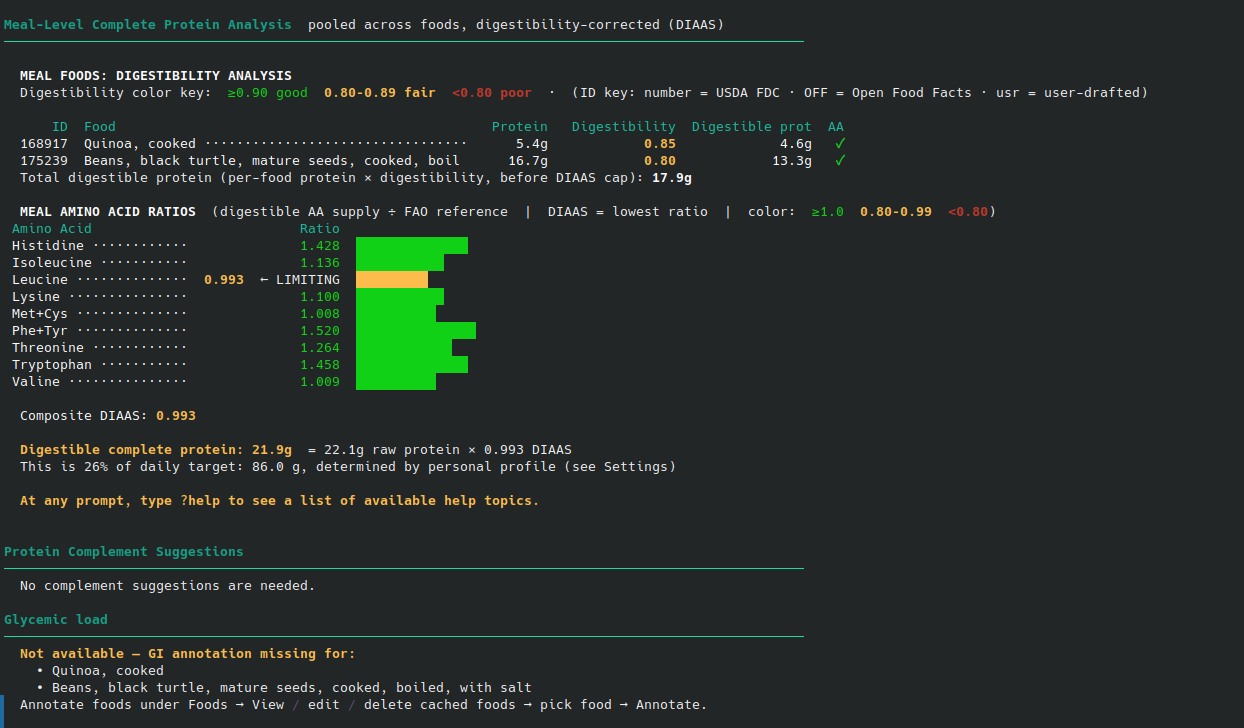
Here is the digestibility and protein completeness analysis for the protein in this meal.
It looks like I got lucky. This is NOT what usually happens with a plant-based meal, unless one is able to intelligently plan it. These protein foods are quite digestible, though not so much so as typical animal proteins. The figures in the digestibility column show the percentage of raw protein that is available to a human. If it all were, the figures would be 1.0. The amino acid table below the digestibility analysis shows the mix of the 9 essential amino acids (more about this below) in this meal.
The ratios shown in the table will likely be the most challenging concept a user will deal with in this whole analysis. It is taken up in detail in the User Manual.
Pay close attention to this next part of the analysis:
Not all the protein is digestible, but what there is is high quality. How do we know that? The column of ratio figures tell us. Ideally the ratios are all 1.0 or above, but if the lowest one (the "limiting amino acid" - a phrase you hear a lot in this program) is close enough to 1.0 it is essentially rounded up. In this case that is what has happened. That is why there are no protein complement suggestions.
This all looks great. BUT...it was a big meal, and I only got 25% of my needed daily protein. This clearly suggests one of the problems with plant-based eating: getting enough protein for those in high need groups, like older people and the chronically ill, can be a real problem due to the volume of food that must be consumed.
What this means is that it is absolutely essential that we achieve the highest level of quality protein in a given volume of food - say a meal. Even then the volume of food to be consumed may be challenging, given that appetites in older and sick people are anything but hearty.
The core of the problem: Protein accessibility and quality
Many substances are required for use to continue living. Protein is a vast class of nutrient substances which are absolutely fundamental to our survival.
Protein is used in the biochemical construction of every cell in our body, and as a substance is second only water in it mass in our bodies. Collagen is the most common protein we have, making up about 6% of our body weight. About 30% of our bones are collagen, and it comprises large amounts tendons, ligaments, cartilage, skin, and muscle. 1
Note that lean people have more protein by percent body weight than do less lean people.2
The need for protein is related to cell death
No cell lives forever, but some live much longer than others. The cells lining our gut live short, glorious lives on the front line - lasting 3 to 5 days.3 Red blood cells normally live about 120 days, after which they are consumed by microphages, specialist white blood cells that are a part of our innate immune system.4 5
Neurons are particularly interesting. Our brain is initially equipped with huge number of neurons, but in rather constrained period around the time of birth about half of them are eliminated because they are not sufficiently stimulated or otherwise marked for survival.6 7
Neurons that survive last for life. But their connections to other neurons well may be affected by the ongoing process of learning and development. From birth to late childhood, synaptic connections approximately double. Then, in adolescence a process of synaptic pruning that began shortly after birth dramatically accelerates and continues into about the late 20s.8
(What follows is an early first draft. Sources are not provided, but will be later.)
It is well known that sarcopenia - the progressive, age-related loss of skeletal muscle mass, strength, and physical function substantially impact mortality, hospitalization risk, and quality of life for among older adults. Globally, it is estimated to affect 10% to 40% of non-hospitalized older adults.
A key factor driving this is the progressive failure of protein utilization processes to properly service muscle cells over time. Also significant factors are decreasing physical activity and decreasing levels of protein consumption. Other, more complex biochemical factors also drive this serious muscle loss dynamic. The bottom line is that older people not only deliberate, well focused resistance exercise, they also need major increases in protein volume and close attention to protein quality.
We must worry first about digestibility, and then about protein quality
Protein quality has two aspects: digestibility ("bioavailability"), and completeness. When you read on your jar of peanut butter (an excellent protein source) that 2 tablespoons contain 7 grams of protein (a bit more than that in a large egg), what it doesn't tell you is that only a bit less than 4 grams is actually digestible by human bodies, and of that only a little over 2 grams is complete protein - the kind found in an egg or a piece of chicken meat, and the kind we need.
"Completeness" of a protein source is a bit complex. Most simply put, is has to do with the mix of the various sorts of protein in a food. Of the 20 protein building blocks we need (amino acids) we can ourselves make all but 9. We also need them in certain amounts, and within about a 24-hour period, if they are to be useful.
So, if you eat a food that is rich in protein but it is lacking a sufficient amount of just one of those 9 indispensable amino acids (IAA), to the degree that single amino acid is missing the rest of the proteins will be used for energy - stored as fat or broken down into metabolizable components, with what can't be used excreted in your urine.
The problem with peanut butter is its mix of IAAs. The problem with that egg and potato breakfast mentioned earlier is the sheer amount of protein in it, PLUS the mix of IAAs.
I recently became aware both of the fact that older people need about double the protein younger people need, and also the fact that many plant proteins simple never make it into our bloodstream beyond a certain point. This was critical new information for me, and it meant that up until this point I simply have not been eating enough protein, for most of my life. If this is true for me, it's certainly true
The protein consumption problem for older people goes far beyond the picture given us about 50 years ago by Lappe's critically important book Diet for a small planet.9
Nutrimagnus shows us the picture
At this point, let's check in on my breakfast.
NutriMagnus is a computer program written in the Python language. Built out of a large number of separate modules, it accesses two major online databases as sources of information about food, keeps several internal databases of its own, and encourages the user to create a database which then becomes the first place it looks for food information - your "pantry".
Homepage
WEB version
CLICK TO ENLARGE -- PRESS ESC TO RETURN
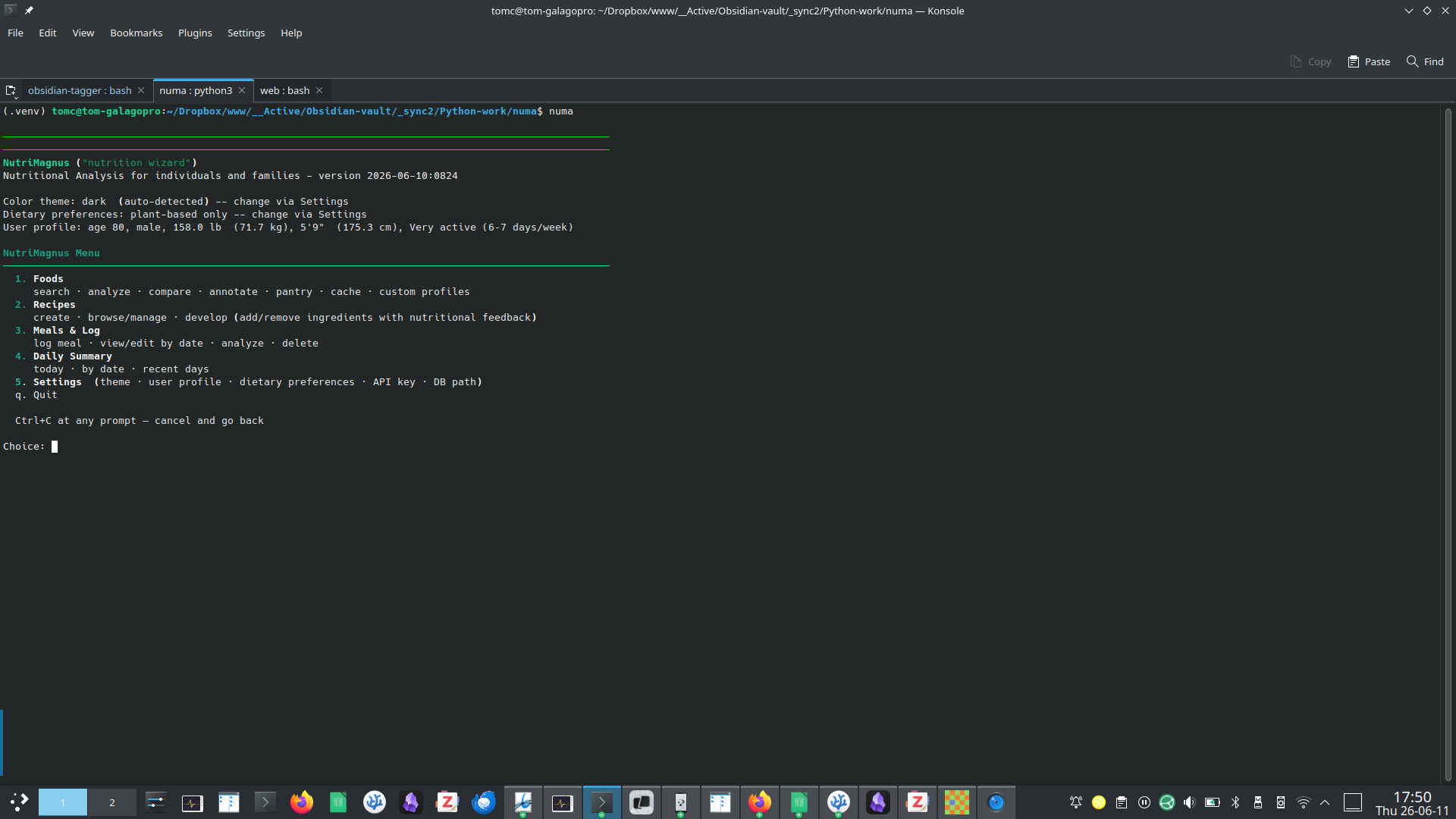
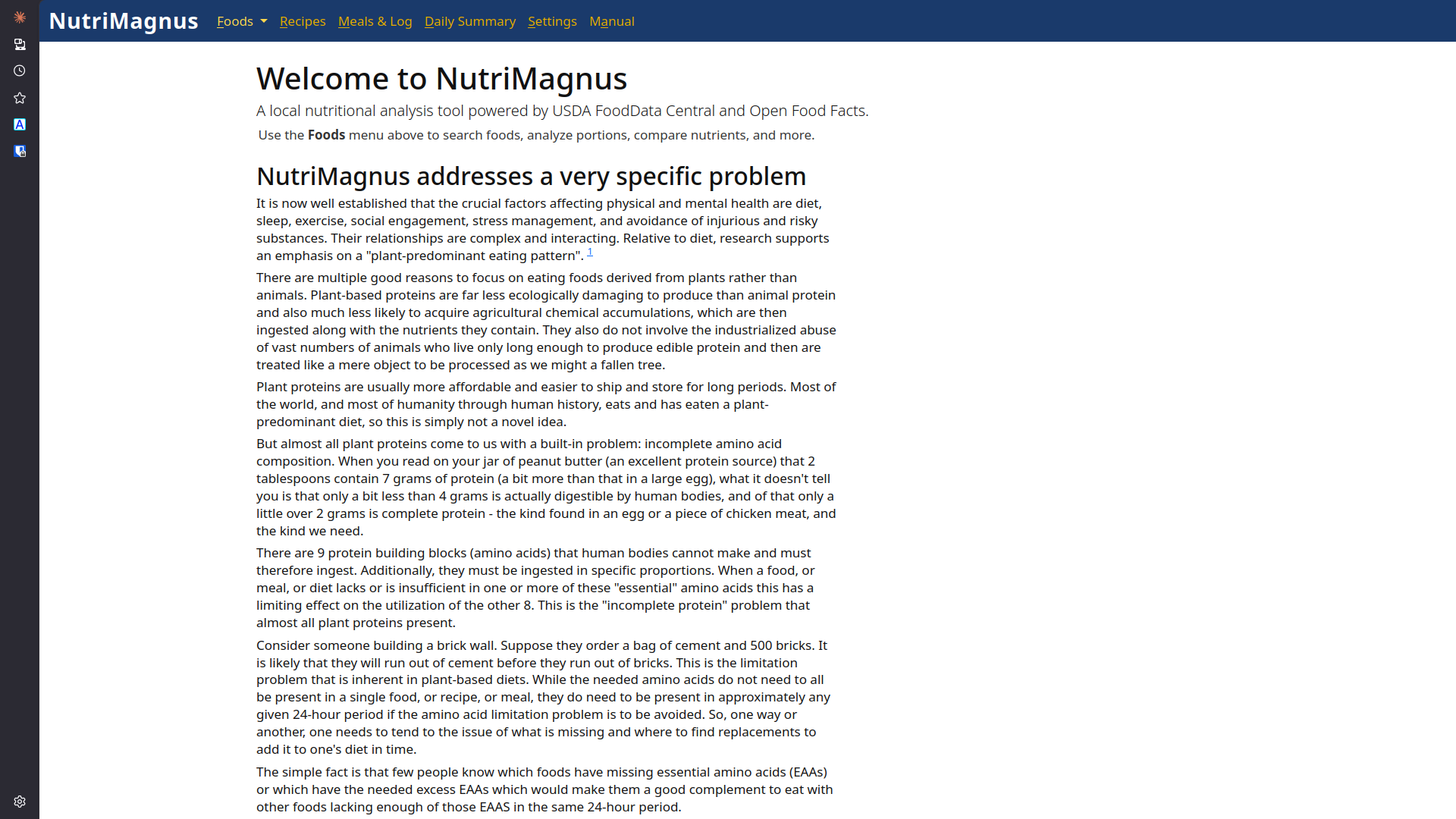
There are two versions of the program one runs in a terminal emulator - basically an empty screen on your computer that you type into to communicate with the program. This is the "CLI" (Command Line Interface) version. The other version runs in your browser. I'll show you a little of the CLI version, but most of what follows will show you the browser version, as it will look more like what you're used to seeing on your screen, and will operate in a way that is more familiar to you.
Launching the program, this is what the command line version looks like. On your screen it will likely look a little different, but the text and menu is what you should notice here.
There is clearly a lot of empty space. But, that space will be FULL of information soon. For showing a lot of detail, the CLI version is superior to the browser version. But, you do need to get used to communicating with the program entirely through your keyboard. This needlessly freaks out some folks. Think of it as texting with your computer. You know how to text. You can do this!
Browser version
CLICK TO ENLARGE -- PRESS ESC TO RETURN
The browser home page has an essay explaining the rational for of this program - why it's needed and what it does.
The 5-part menu you see in the CLI screenshot is now seen in as the program's "navigation strip" across the top of every page the program has, including this one.
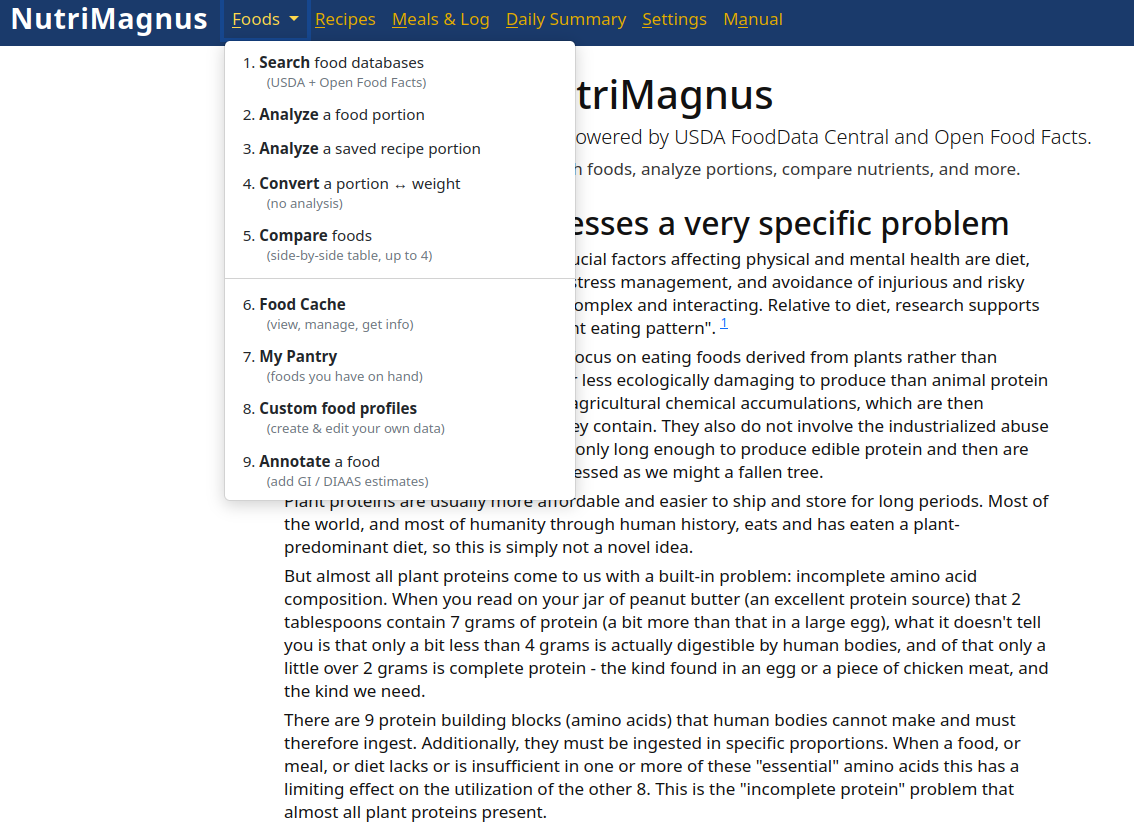
You can click on any menu link and a drop-down menu will appear.
Food menu
CLI version
CLICK TO ENLARGE -- PRESS ESC TO RETURN
WEB version
CLICK TO ENLARGE -- PRESS ESC TO RETURN
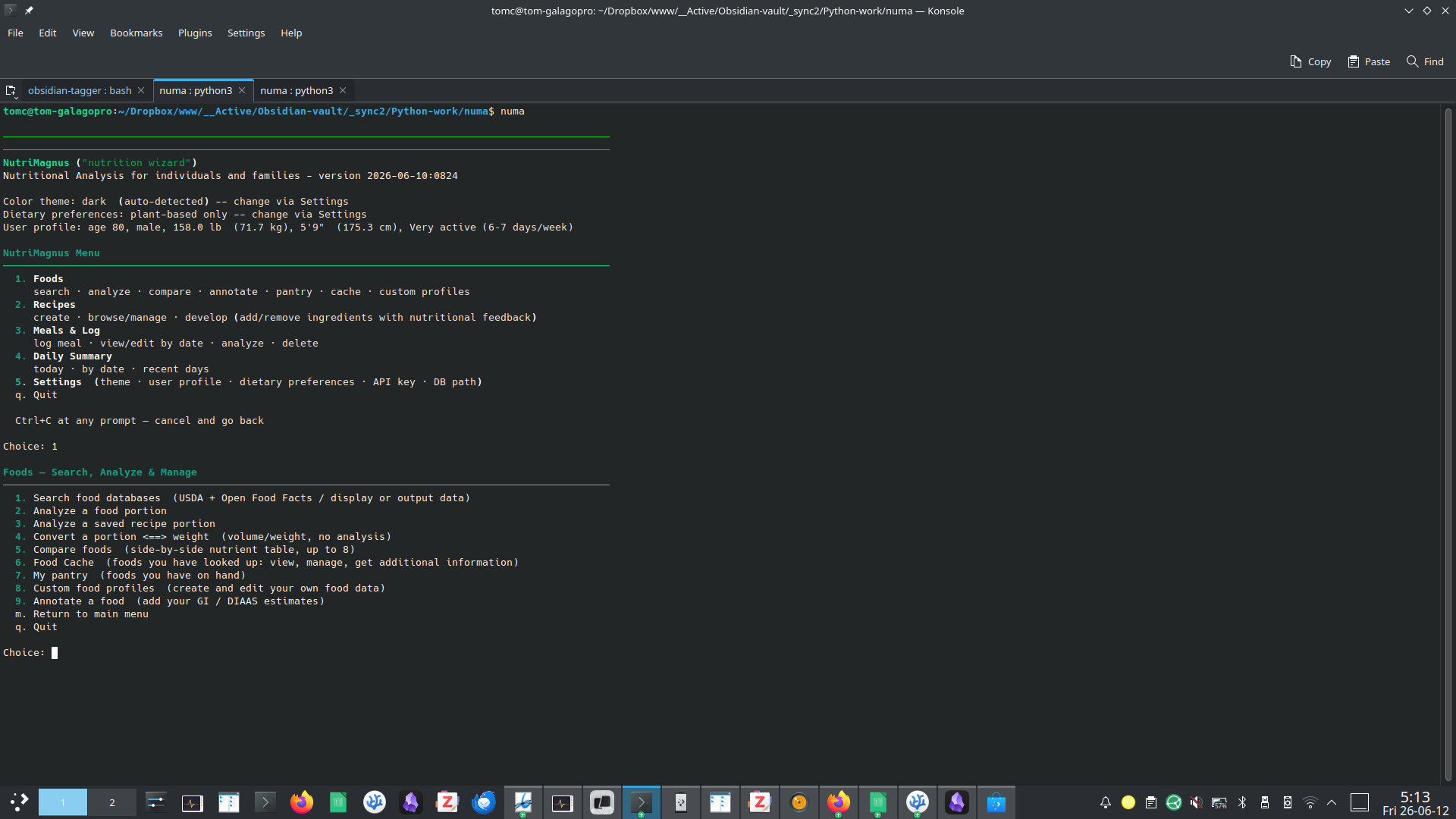
Working in the terminal with the command line, directly-typed numbers access menu items. It's fast and simple, and your hands never leave the keyboard.
In the browser version, both the main menu and the items in the drop-down menus may be accessed either by clicking or by using your keyboard directly - but keyboard "access keys" are an option that only works in a Firefox browser. Perhaps in the future this feature will be available in the Chrome browser.
The nine items on the Food menu are well described in the User Manual. Have a look now, and use your browser's back button to return here.
Next, let's look at the analysis shown for a single food - pinto beans.
At this point I am stopping for the day. Tomorrow, we'll look at a couple more menus, then look at the beginning of a day's meal and the protein challenges it presents. Work on validating the program - now focused on the suggested protein complements - and on further developing the browser version of the program will also continue.
Notes ^
-
Maricopa Open Digital Press. (2020). Protein – Nutrition Essentials. Open educational resource drawing on standard human nutrition biochemistry. https://open.maricopa.edu/nutritionessentials/chapter/protein/ ↩
-
University of Hawai'i at Mānoa. (n.d.). Defining protein – Human Nutrition. OER textbook, FSHN 185. http://pressbooks.oer.hawaii.edu ↩
-
Park, J. H., et al. (2016). Promotion of intestinal epithelial cell turnover by commensal bacteria: Role of short-chain fatty acids. PLOS ONE, 11(5), e0156334. https://doi.org/10.1371/journal.pone.0156334 ↩
-
Bhatt, A., & Bhatt, D. (2021). How do red blood cells die? Frontiers in Physiology, 12, 655393. https://doi.org/10.3389/fphys.2021.655393 ↩
-
Zhang, H., et al. (2024). Recent advances and clinical applications of red blood cell lifespan measurement. Heliyon. https://doi.org/10.1016/j.heliyon.2024.e36554 ↩
-
BrainFacts.org / Society for Neuroscience. (2023, January 16). Neural pruning and apoptosis. https://www.brainfacts.org/thinking-sensing-and-behaving/brain-development/2023/neural-pruning-and-apoptosis-011623 ↩
-
ScienceInsights. (2026). Which are true about apoptosis in the brain? https://scienceinsights.org/which-are-true-about-apoptosis-in-the-brain/ (drawing on Oppenheim, R. W., 1991, Annual Review of Neuroscience, and related foundational literature on developmental neuronal death) ↩
-
Huttenlocher, P. R. (1979). Synaptic density in human frontal cortex: Developmental changes and effects of aging. Brain Research, 163(2), 195–205; as summarized in: Scientific American. (2024, February 20). Why is synaptic pruning important for the developing brain? https://www.scientificamerican.com/article/why-is-synaptic-pruning-important-for-the-developing-brain/ ↩
-
Lappe, F. M. (1971). Diet for a small planet. Ballantine. /Library. https://www.amazon.com/Diet-Small-Planet-Revised-Updated/dp/0593357779/ ↩
☀ ☀ ☀